

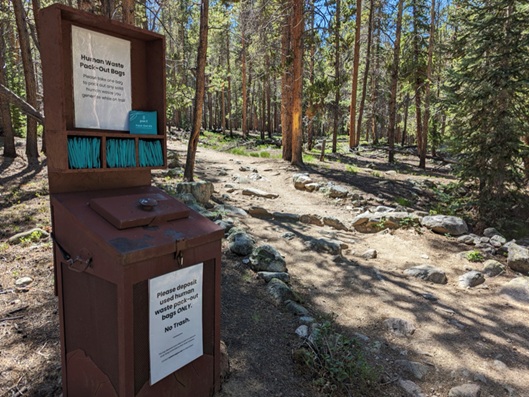
A first-of-its-kind study conducted on Mt. Elbert, Colorado’s highest peak, found that the vast majority of alpine hikers are willing to pack out their human waste. Indeed, the study revealed that the biggest barrier to responsible backcountry waste disposal; it’s having the right tools. And hikers are willing to foot the bill to be more prepared.
The findings, field study on Colorado’s Fourteeners, have significant implications for land managers and trail organizations working to address a growing waste problem in high-use alpine environments. But they also suggest outdoor retailers could do their part by making waste disposal product more visible and more accessible in store.
The study was conducted in the summer of 2024 by researcher Jack Edelson of The Pennsylvania State University in partnership with PACT Outdoors, Leave No Trace, the Colorado Fourteeners Initiative, and the U.S. Forest Service. It involved installing a kiosk with free waste pack-out bags at the North Summit Trailhead during peak season, with Edelson surveying 410 hikers returning to the trailhead over 19 days.
The Problem
Above treeline, traditional cat-hole burial is not an appropriate waste disposal method. With rocky soil and limited biological activity to aid decomposition, human waste can persist for years in alpine environments, contaminating water sources and degrading fragile ecosystems. Despite this, most hikers arrive unprepared with the recommended alternative: a human waste pack-out bag to haul out their waste.
Where Hikers ‘Go’
Popular peaks like Mt. Elbert draw 15,000–20,000 hikers per year during the summer months. The study found that 11% of hikers pooped at or on Mt. Elbert, with 70% of those bathroom stops occurring on the mountain, beyond the reach of trailhead facilities. That extrapolates to more than 1,100 poops on the mountain each year.
The research delivered a clear and actionable finding: hikers aren’t refusing to pack out — they simply don’t have the tools. Of all hikers who used a pack-out bag on the mountain during the study period, 92% used one obtained from the free kiosk installed at the trailhead.
87% of hikers said they would consider using a pack-out bag on a future backcountry trip, and 80% said that trying a free bag would make them more likely to bring one in the future.
“We invested in this research because we believe the barrier to practices like packing out isn’t attitude — it’s preparedness. Even with a less desirable practice like packing out your poop, if hikers have the right tools, they will comply.” — Jake Thomas, Co-founder, PACT Outdoors
Hikers also said they are willing to pay $3.00 for a waste pack-out bag obtained at a trailhead kiosk — a price point the study’s economic modeling suggests is sufficient to make a bag program financially self-sustaining. At $3 per bag with a trailhead dispenser, the study projects a 77% adoption rate among visitors. A program that offers free bags projects an 89% adoption rate.
“This is the first study to apply consumer preference modeling to backcountry stewardship practice. The results were unambiguous: when given the option at the trailhead, hikers use pack-out bags at very high rates — and the program can be designed to cover its own costs. That’s meaningful for anyone managing high-use wilderness areas.” — Jack Edelson, Doctoral Researcher, Department of Recreation, Park, and Tourism Management, The Pennsylvania State University