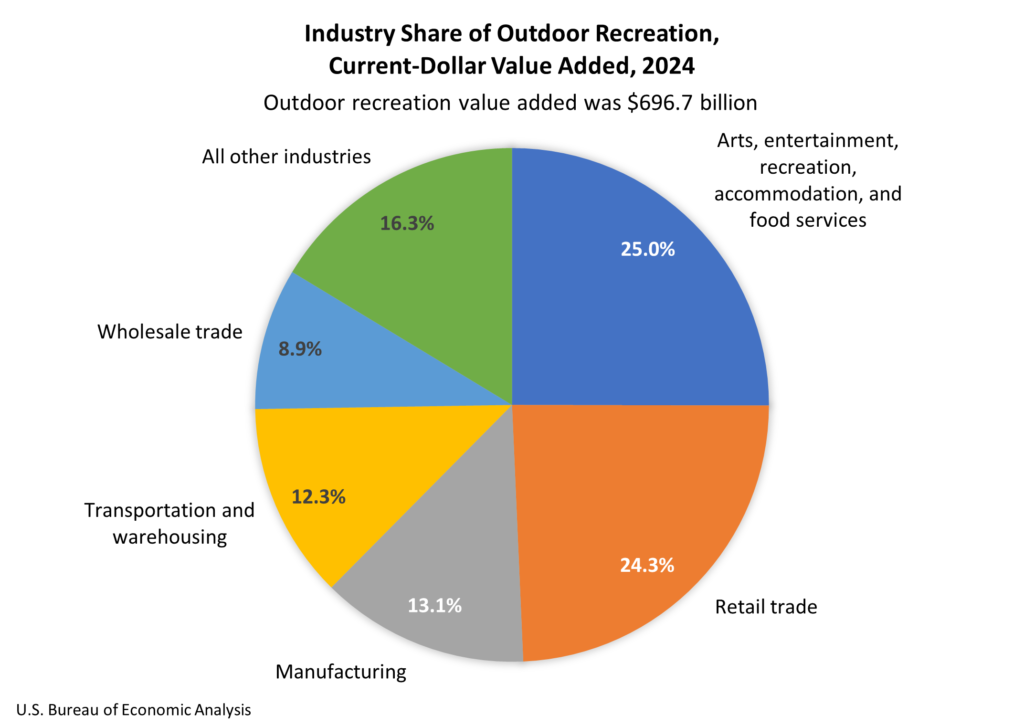


The U.S. Bureau of Economic Analysis (BEA) last week released new statistics measuring the outdoor recreation economy for the nation, covering the 50 states and the District of Columbia. Overall, data shows the value added of the outdoor recreation economy accounted for 2.4 percent ($696.7 billion) of current-dollar gross domestic product (GDP) for the nation in 2024.
Across states and the District of Columbia, value added for outdoor recreation as a share of state GDP ranged from 6.1 percent in Hawaii to 1 percent in the District of Columbia.
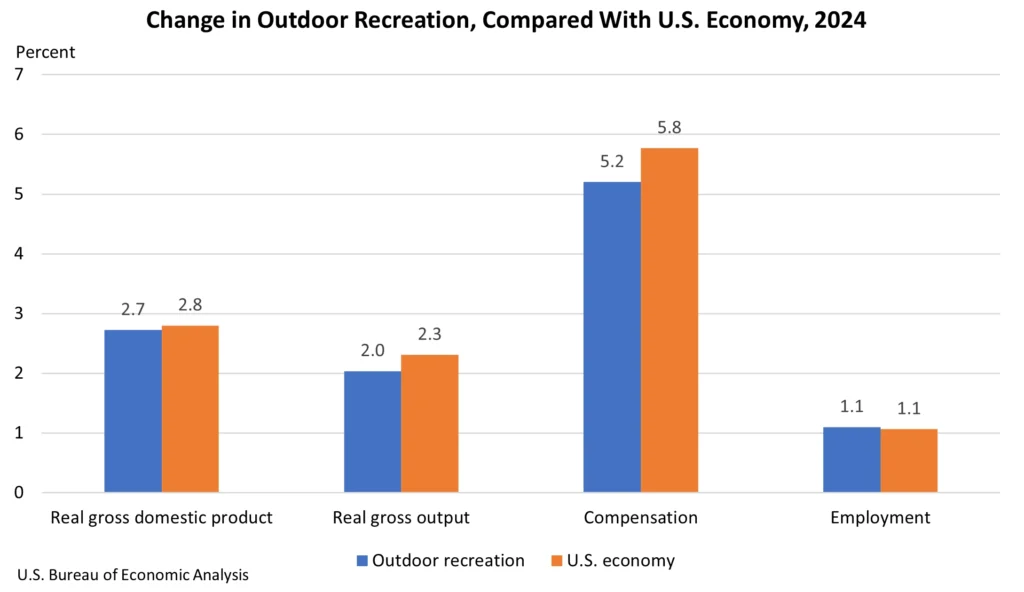
Inflation-adjusted (“real”) GDP for the outdoor recreation economy increased 2.7 percent in 2024, compared with a 2.8 percent increase for the overall U.S. economy, reflecting a deceleration from the 5.3 percent increase the outdoor industry registered in 2023. Real gross output for the outdoor recreation economy increased 2 percent, while outdoor recreation compensation increased 5.2 percent and employment increased 1.1 percent.
The BEA report organizes outdoor recreation activities into three general categories: conventional activities (bicycling, boating, hiking, hunting, etc.), other activities (gardening and outdoor concerts) and supporting activities (construction, travel and tourism, local trips, and government expenditures).
In 2024, conventional outdoor recreation accounted for 29.5 percent of U.S. outdoor recreation value added, compared with 30 percent in 2023. “Other outdoor recreation” accounted for 19 percent (18.8 percent in 2023), while supporting activities represented the remaining 51.5 percent of value added in 2024, which was a slight increase compared with 51.2 percent in 2023. Growth in supporting activities was led by travel and tourism, which reflects growth in spending on transportation, hotels and restaurants, according to the report.
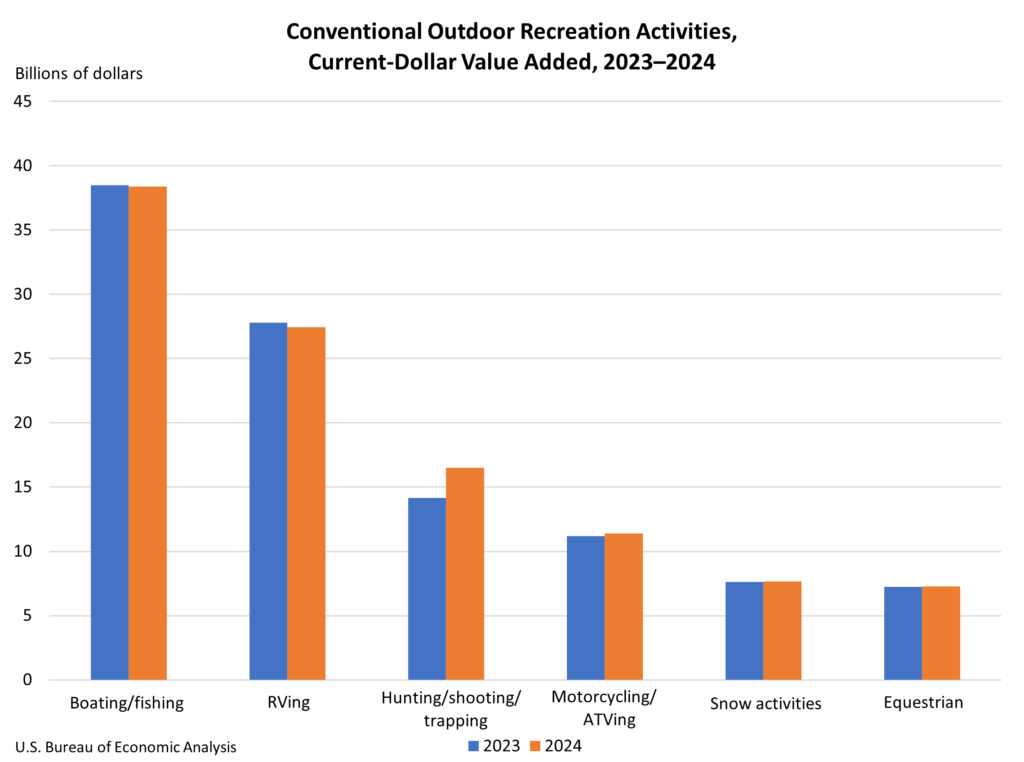
In terms of activity impact, boating/fishing was the largest conventional activity across the nation at $38.4 billion in current-dollar value added and was the largest conventional activity in 34 states. The states with the largest contributions were Florida ($4.4 billion), California ($3.3 billion) and Texas ($3.0 billion).
RVing was the second-largest conventional activity for the nation at $27.5 billion in current-dollar value added and was the largest conventional activity in nine states. Hunting/shooting/trapping was third at $16.5 billion and was the largest conventional activity in Arizona and Wyoming.
Elsewhere, snow activities across the nation accounted or $7.6 billion in current-dollar value added and was the largest conventional activity in four states (Colorado, New Hampshire, Utah, and Vermont). The states with the largest contributions were Colorado ($1.6 billion), California ($730.5 million) and Utah ($598.2 million).
In terms of outdoor recreation by industry segment, the arts, entertainment, recreation, accommodation, and food services group was the largest contributor to U.S. outdoor recreation current-dollar value added in 2024, accounting for $174.4 billion or 25 percent.
Retail trade was the second-largest industry group at $169.1 billion (24.3 percent of value added) and was the largest industry group in 24 states. The states with the largest contributions were California ($19.3 billion), Texas ($14.4 billion) and Florida ($13.4 billion).
Manufacturing was the third-largest industry group accounting for $91.3 billion (13.1 percent of value added) and was the largest industry group in two states (Indiana and Louisiana). The states with the largest contributions were Texas ($13.1 billion), California ($11.6 billion) and Indiana ($9.1 billion).